No country does castles quite like Britain. Nearly a thousand years of them stand across the land: the Norman power-statements of Windsor and the Tower, the vast coastal fortresses of Northumberland, Edward I's ring of mighty castles thrown up to hold down Wales, and the clifftop strongholds where Scotland's history was fought out. Some are lived-in and immaculate, some are romantic ruins, and between them they tell the whole story of these islands. This is a guide to the greatest of them — and, because a castle on a crag is not always an easy visit, an honest one about access.
Every castle here carries an access note. Some have lifts, ramps and accessible routes to at least the grounds and lower halls; others are steep, cobbled and stepped by their very nature, and we say so plainly rather than promise. Access details change with each property, so we'd always ask you to check ahead. This guide grows as we add castles.
England
From royal Windsor and the Tower to the great coastal fortresses of the north.
Windsor Castle

The Queen's Berkshire home for 900 years. See the grand State Apartments and St George's Chapel.
This is the largest and oldest inhabited castle on earth. It has been a royal residence since William the Conqueror. Inside are the richly decorated State Apartments and St George's Chapel. You can also watch the Changing of the Guard.
Our tip Time your visit for the Changing of the Guard. The State Apartments are the highlight.
Visiting — good to know
Partial wheelchair access
The State Apartments have level and lifted access with clear routes and audio tours are usually offered; the cobbled courtyards and some spiral stairs are uneven, and it is busy — go early for quieter navigation.
For blind & low-vision visitors The State Apartments have level and lifted access with clear routes and audio tours are usually offered; the cobbled courtyards and some spiral stairs are uneven, and it is busy — go early for quieter navigation.
Sensory Busy and often crowded, with lively courtyards and echoing stone halls; early or late in the day is quietest, and the State Apartments are calmer than the changing-of-the-guard crowds.
Access last checked 5 Jul 2026 — always confirm with the venue.
Worth watching
- Khaleel Chima Reports on Windsor Castle & its Accessibility Ability Today
- Windsor Castle, England | A Walking Tour Inside Queen Elizabeth's Castle Tours by Foot - London
More Wikipedia
Tower of London

The riverside fortress of the Crown Jewels, the Yeoman Warders and the ravens.
William the Conqueror's White Tower has been palace, prison and treasury; today the Crown Jewels dazzle, the Beefeaters tell its bloody tales, and the ravens still guard the realm.
Our tip Join a free Yeoman Warder tour — they bring the grim history vividly to life.
Plan your visit
- Opening
- Open year-round on a day-by-day calendar: summer sample Tue–Sat 9am–5.30pm, Sun–Mon 10am–5.30pm with last entry 4.30pm; shorter winter hours with last entry 3pm. Closed 24–26 Dec 2026 and 1, 4–5 Jan 2027. Middle Tower works until mid-Aug 2026 (Middle Drawbridge is the entrance); check the calendar for temporary route closures.
- Admission
- Adult £37, child 5–15 £18.50, under-5s free, senior/student/disabled concession £29.50, carer/companion free (optional 10% donation on top). £1 advance-online tickets for Universal Credit and other named benefits; Tower Hamlets residents £1 on the day. No family ticket. No on-site car park — nearest Blue Badge bays are the third-party Tower Hill Coach and Car Park.
- Booking
- Timed-entry slots: book online in advance (essential at busy times, and £1 tickets are advance-only) or buy at the ticket office on the day. One entry only, no re-entry; bag check on the way in.
- Allow
- Officially at least two to three hours — quietest after 1pm, and you can stay all day.
Visitor information checked 21 Aug 2026. Opening and prices can change.
Visiting — good to know
Partial wheelchair access Accessible toilets Companion goes free — all visitors
Broadly level in the outer wards with well-defined routes and audible Yeoman Warder tours as orientation, but cobbles are extensive and the towers have steep spiral stairs; the Crown Jewels hall is level.
For blind & low-vision visitors Broadly level in the outer wards with well-defined routes and audible Yeoman Warder tours as orientation, but cobbles are extensive and the towers have steep spiral stairs; the Crown Jewels hall is level.
Sensory A bustling site with crowds, echoing towers and tour-group noise; mornings on opening are quietest, the Crown Jewels queue the most pressured.
Companion concession Each disabled visitor can bring one carer or companion free; one free carer ticket can be added per online booking, and more can be arranged by emailing info@hrp.org.uk with the booking reference. The venue states it always keeps capacity aside and would never turn away a carer. Proof accepted: Blue Badge, Freedom Pass, DLA letter or PIP letter, shown at the Ticket Office on the day; only the concession holder needs documents.
Access last checked 11 Jul 2026 — always confirm with the venue.
Worth watching
- Tower of London Tour | A Virtual Walk through the Inside of the Tower Tours by Foot - London
- Tower of London | FULL WALKING TOUR | History of the Tower of London MemorySeekers
More Tickets · Venue access information · Wikipedia
Also featured in Accessible London
Bamburgh Castle

The definitive Northumberland castle, riding a crag over miles of pale sand.
A huge red-sandstone fortress on a ridge of volcanic rock above one of England's finest beaches — the ancient royal seat of Northumbria, restored by the Victorian arms magnate Lord Armstrong.
Our tip Pair it with a walk on the magnificent beach below.
Plan your visit
- Opening
- 2026 season: open daily until 8 November, 10am–5pm with last castle entry 4pm (State Rooms 4.15pm, West Ward 4.30pm). Exceptional closures: 9–10 July (private hire) and 9–13 November for Christmas installation. The venue's FAQ page still shows older, shorter hours — the Visit Us page carries the current season's times, so confirm before travelling.
- Admission
- Standard 2026: adult £19.95, child 5–16 £10, under-5s free, family £58.50; reduced summer prices 25 June–1 September (adult £17.46). Accessibility rate for disabled visitors (adult £14.65 standard, £12.82 summer) and carers free. Car park £6 per day. The site is cashless — card or contactless only.
- Booking
- Pre-booking strongly recommended (admission can be capped at capacity) but tickets are also sold on arrival. No timed slots — arrive any time between opening and last admission. Tickets are date-specific and non-refundable.
Visitor information checked 11 Jul 2026. Opening and prices can change.
Visiting — good to know
Partial wheelchair access Accessible toilets Companion goes free — all visitors
Ramp (1:6) into the King's Hall gives wheelchair access to the first five rooms; wheelchairs are not permitted beyond this point on health-and-safety grounds due to steps and narrow passages. Steep steps to the western ward and battery terrace.
For blind & low-vision visitors Reached up a steep approach; inside, the grand rooms have uneven floors and cobbled ramps, with open drops from the ramparts — a sighted guide helps.
Sensory Usually calm and uncrowded, with the constant sound of wind and sea; the grand halls echo but it rarely feels overwhelming.
Companion concession One carer aged 18 or over is admitted free per disabled visitor; disabled visitors themselves pay a reduced Accessibility rate, which the venue says reflects that not all of the staterooms are accessible. Proof accepted: Blue Badge, PIP letter, or Access Card.
Access last checked 11 Jul 2026 — always confirm with the venue.
Worth watching
More Tickets · Venue access information · Wikipedia
Also featured in The accessible Northumberland coast in three days
Dover Castle

A mighty medieval fortress over the white cliffs, with secret wartime tunnels.
Guarding the shortest crossing to France for nine centuries, Dover pairs a great Norman keep with the Secret Wartime Tunnels from which the Dunkirk evacuation was directed.
Our tip The wartime tunnels are the standout — allow time for the underground tours.
Plan your visit
- Admission
- Tickets are free for members. You can still book online if you’d like – just remember to bring your English Heritage membership card.
- Booking
- You can book online until midnight the day before your visit to get the discount. You can still buy a ticket on the day of your visit online or when you arrive, but you’ll pay full price.
Visitor information checked 15 Jul 2026. Opening and prices can change.
Access not yet checked — please confirm with the venue before you travel.
Worth watching
- ARE HEVER AND DOVER CASTLES ACCESSIBLE? Lord and Lordettes
- Dover Castle (Autistic On Tour) AutisticOnTour
More Wikipedia
Also featured in Kent, the Garden of England
Alnwick Castle

England's second-largest inhabited castle, a film star beside a spectacular garden.
The Duke of Northumberland's home doubled as Hogwarts on film; grand state rooms sit beside the dazzling contemporary Alnwick Garden with its Grand Cascade and Poison Garden.
Our tip Broomstick-flying lessons run in the courtyard where Harry learned to fly.
Plan your visit
- Opening
- Open daily in season (late March to 22 October 2026): grounds 10am–5pm with last entry 3.45pm; State Rooms 10.30am–4.30pm, last entry 4pm. Closed over winter.
- Admission
- 2026 online prices (10% below the gate, and every online ticket becomes a 12-month season pass): adult £22, concession (60+/students) £17.90, child 5–16 £11.60, family £64.20, under-5s free; lower summer-savings prices 25 June–1 September. Castle and garden car park £3.75 per day.
- Booking
- No booking required — tickets are sold on arrival — but booking online saves 10% and gives unlimited return visits for a year. Free mobility scooters must be pre-booked on 01665 511178.
- Allow
- At least 2–3 hours (official recommendation).
Visitor information checked 11 Jul 2026. Opening and prices can change.
Visiting — good to know
Partial wheelchair access Accessible parking Accessible toilets Companion goes free — all visitors
Grounds mix cobbles, grass, gravel and stairs. State Rooms reached via steps (staff-provided manual wheelchair, one-person seated lift, no ramps). Disabled parking ~600m from Garden car park.
For blind & low-vision visitors The state rooms are largely level with clear routes; the cobbled courtyards are uneven, while the adjoining Garden has smooth, well-defined accessible paths.
Sensory Can be busy in the state rooms and gardens in season with tour groups; the vast grounds give plenty of quiet, open space to step aside.
Companion concession One carer accompanying a disabled visitor is admitted free; the disabled visitor holds a valid ticket and the free carer ticket is issued on arrival. Contact the castle before visiting with any eligibility questions. Proof accepted: A letter confirming Carer's Allowance or local-authority carer recognition, a GP letter confirming carer status, or a recognised carer card (CredAbility, CEA Card); Blue Badge and PIP/DLA letters are not named on the official page.
Access last checked 11 Jul 2026 — always confirm with the venue.
Worth watching
- Alnwick Castle & Walkmill Campsite Tour - Northumberland Yorkshire Pop Top Adventures
- NORTHUMBERLAND BY WHEELCHAIR! Alnwick Garden And Castle, Barter Books, And Vegan Foodie Finds [CC] Pippa Stacey
- Alnwick Castle - Kerstin's Deaf Travel Kerstin Fox
More Tickets · Venue access information · Wikipedia
Also featured in The accessible Northumberland coast in three days
Warwick Castle

A great riverside fortress of towers, ramparts and daily shows.
One of England's finest medieval castles, above the Avon, now run as a lively attraction with a trebuchet, birds of prey, a dungeon and towers to climb.
Our tip The giant working trebuchet is fired daily in season.
Memberships and passes
- Merlin Annual Pass — restrictions apply: Standard admission may be included, depending on pass type, restriction date and attraction rules. Pre-booking can be required; extras may cost more. Official terms (checked 8 Aug 2026)
Visiting — good to know
Partial wheelchair access
Cobbled, uneven surfaces through the courtyard with some slopes; the ground-floor state rooms are level, but the towers and ramparts involve long flights of steep steps and cannot be reached step-free.
For blind & low-vision visitors A busy, theatrical site with cobbles, ramparts with open drops and many steps; the ground-floor state rooms are level. Loud shows give audible landmarks but crowds disorient.
Sensory The most sensory-intense castle — loud staged shows, birds-of-prey displays, crowds and cannon bangs; those sensitive to noise should check show times and seek the quieter ramparts and gardens.
Access last checked 5 Jul 2026 — always confirm with the venue.
Worth watching
- Warwick, England: Medieval Castle - Rick Steves’ Europe Travel Guide - Travel Bite Rick Steves' Europe
- Warwick Castle Tour 2026 | Complete England Travel Guide | Great Britain Sticks-World
- How easy is Warwick Castle to get around as a wheelchair user? Having a wheelie great life
More Wikipedia
Also featured in UK Merlin attractions · A weekend in Warwickshire
Leeds Castle

A storybook castle rising from its own lake in 500 acres of Kent parkland.
Built on islands in a lake, Leeds has been a Norman stronghold, a royal palace and a country retreat, with a maze, aviary and gardens filling a full family day.
Our tip Allow most of a day — there's far more than the castle.
Visiting — good to know
Accessible parking Accessible toilets
Visitors should be aware that there are approximately 45 metres of cobblestones across the drawbridge onto the Castle Island.
Vision services The Mikro audio guide features two headphone jacks (for visitors who may need to assist a person with visual impairments), raised keypad for visitors with visual impairments, full-colour LED screen for high-quality images and video, and ergonomic design for the comfort of our visitors.
Sensory Sensory Packs are now available for hire from the Visitors Centre at Leeds Castle. These packs are primarily aimed at children and young people with neurodiversity and/or other disabilities, who may find our beautiful estate overwhelming at times.
For D/deaf & hard-of-hearing All of our audio/multimedia guides have been designed with dual headset jacks (without the need of an adaptor), this feature is a benefit for visitors with visual impairments. For example, they can share a device with a companion who can help guide them through the site. Accessibility is something our provider Orpheo takes seriously, which is why all of our devices are also compatible with induction loops for the hearing impaired.
Access last checked 15 Jul 2026 — always confirm with the venue.
Worth watching
More Tickets · Venue access information · Wikipedia
Also featured in Kent, the Garden of England
Bodiam Castle

A picture-book 14th-century castle rising from a wide, lily-fringed moat.
Everyone's idea of a castle, Bodiam's rounded towers reflect perfectly in its broad moat, though behind the walls it is a romantic shell — a wonderful place for families. National Trust.
Our tip Climb the spiral stairs to the battlements for the view into the moat.
Plan your visit
- Admission
- Free entry for National Trust members.
- Booking
- You don't need to book your visit in advance.
Visitor information checked 15 Jul 2026. Opening and prices can change.
Visiting — good to know
Partial wheelchair access Accessible parking Accessible toilets Hearing loop Assistance dogs welcome
Gravel paths throughout the site with some slopes and undulating terrain. Level access to the castle courtyard only. The towers are reached by steep spiral staircases.
Vision services Braille guides (SEB and VEB versions) available on request
Access last checked 15 Jul 2026 — always confirm with the venue.
Worth watching
- SANDHURST to BODIAM CASTLE | 26km by Electric Wheelchair 3/4 Chaircam Videos
- BODIAM CASTLE to ROBERTSBRIDGE | 26km by Electric Wheelchair 4/4 Chaircam Videos
More Wikipedia
Also featured in Sussex
Corfe Castle

The jagged, slighted ruins of a royal castle above a Purbeck village and steam railway.
Blown apart by Parliament in the Civil War, Corfe's shattered towers command the gap in the Purbeck Hills above a honey-stone village, with the Swanage steam railway below. National Trust.
Our tip Arrive by the Swanage Railway steam train for the storybook approach.
Access not yet checked — please confirm with the venue before you travel.
Worth watching
More Wikipedia
Also featured in Dorset
Kenilworth Castle

Vast red ruins and a recreated Elizabethan garden of Robert Dudley's grand courtship.
England's finest surviving Elizabethan garden sits beside the mighty red-sandstone ruins where Robert Dudley wooed Elizabeth I with weeks of pageantry. English Heritage.
Our tip The recreated Elizabethan Garden is a highlight in its own right.
Memberships and passes
- English Heritage — entry included: Standard admission to Kenilworth Castle and Elizabethan Garden is included. Advance booking is optional but guarantees entry. The limited-capacity English Heritage car park is free for members displaying a valid member car sticker; nearby Abbey End parking is not managed by English Heritage. Bring the valid membership card, or the accepted confirmation email plus identification while awaiting it. Event admission and booking are event-specific and can be free or reduced rather than universally free. Official terms (checked 11 Jul 2026)
Visiting — good to know
Partial wheelchair access
Gently sloping grass with uneven ground around the sandstone ruins, while the Elizabethan garden has firmer, better-defined paths. Much of the ground level can be experienced on wheels, though rough grass and slopes make it hard going in places.
For blind & low-vision visitors Extensive sandstone ruins on gently sloping grass with uneven ground and open drops from the towers; the Elizabethan garden has firmer, more defined paths.
Sensory A spacious open ruin that stays calm even when busy, with room and birdsong; the garden is a quiet retreat.
Access last checked 5 Jul 2026 — always confirm with the venue.
Worth watching
- Kenilworth Castle | 10 Places That Made England with Dan Snow English Heritage
- Kenilworth Castle Day Out Review | English Heritage | UK Travel Vlog 4K Explore Home Repeat
More Wikipedia
Also featured in A weekend in Warwickshire
Wales
Edward I's ring of world-heritage castles — the finest concentration of medieval fortresses anywhere.
Caernarfon Castle

A colossal polygonal-towered castle and town walls, a World Heritage Site.
The grandest of Edward I's 'iron ring' of Welsh castles, its banded stone and eagle towers modelled on Constantinople; the investiture place of Princes of Wales.
Our tip Climb the towers for sweeping views over the Menai Strait.
Plan your visit
- Opening
- Seasonal: 1 July–31 August 09:30–18:00; 1 September–31 October 09:30–17:00; 1 November–28 February 10:00–16:00. Last entry is 30 minutes before closing. Closed 24–26 December and 1 January.
- Admission
- Adult £15.60 from 1 June–31 August 2026; disabled visitor and companion listed free. From 1 September 2026, adult £14.90.
- Booking
- Tickets can be purchased on arrival or online. Cadw says online prices include a 5% discount and online tickets are non-refundable.
Visitor information checked 21 Aug 2026. Opening and prices can change.
Memberships and passes
- Cadw — entry included: Cadw membership includes standard admission to Castell Caernarfon during normal opening hours, including the Royal Welch Fusiliers Museum, and a free member audio guide. Admission may be obtained on arrival or booked online; online booking only discounts paid tickets. Nearby town and waterfront parking is pay-and-display and is not a membership benefit. Special occasions, out-of-hours events and separately charged events or exhibitions can cost extra. Each named member must show the original membership card, with identity if requested; no refund is due if the card is absent. Official terms (checked 11 Jul 2026)
Visiting — good to know
Partial wheelchair access Accessible parking Assistance dogs welcome
There is ramp access through the King’s Gate and a lift to its upper levels. Ground-level areas have cropped grass and even paths, but much of the castle has steep, narrow and uneven spiral stairs, threshold steps and low door heights. The access guide states that one set of visitor toilets is reached by a ramp, but it does not explicitly identify an accessible toilet. Visitors who may need evacuation assistance from the King’s Gate are advised to contact the castle in advance and reserve a timeslot because emergency evacuation uses a narrow, uneven spiral staircase.
For blind & low-vision visitors A mighty, largely level walled castle with vast open courts, but the wall-walks and towers have steep spiral stairs and sheer drops — keep to ground level without a guide.
Sensory The vast open courts absorb crowds and stay fairly calm; stone towers echo, and the town outside is busier.
Access last checked 11 Jul 2026 — always confirm with the venue.
Worth watching
More Tickets · Venue access information · Wikipedia
Also featured in Three days in North Wales
Conwy Castle

Eight great towers and complete town walls, a World Heritage Site.
One of Europe's finest medieval fortresses, Conwy's eight towers and near-complete ring of town walls survive almost intact from Edward I's conquest of Wales.
Our tip Walk the full circuit of the town walls for the best views.
Plan your visit
- Opening
- Castle: seasonal hours, including 1 July–31 August 09:30–18:00, 1 September–31 October 09:30–17:00 and 1 November–28 February 10:00–16:00; last entry 30 minutes before closing; closed 24–26 December and 1 January. Town Walls: open all year during reasonable daylight hours.
- Admission
- Castle adult £13.50 from 1 June–31 August 2026; disabled visitor and companion listed free. Town Walls are free entry.
- Booking
- Castle tickets can be purchased on arrival or online; Cadw says online prices include a 5% discount and online tickets are non-refundable. The Town Walls have no ticket because entry is free.
Visitor information checked 11 Jul 2026. Opening and prices can change.
Memberships and passes
- Cadw — entry included: Cadw membership includes standard admission to Castell Conwy during normal opening hours and a free member audio guide. Admission may be obtained on arrival or booked online; online booking only discounts paid tickets. Parking is not included: a short-stay pay-and-display car park is immediately outside and a long-stay car/coach park is outside the town walls. Special occasions, out-of-hours events and separately charged events or exhibitions can cost extra. Each named member must show the original membership card, with identity if requested; no refund is due if the card is absent. Official terms (checked 11 Jul 2026)
Visiting — good to know
Partial wheelchair access Accessible parking Accessible toilets Assistance dogs welcome
The castle approach from the visitor centre is a steep path of about 50 metres with steps. Castle grounds have grass and flat cobbled paths, while the great hall, east barbican, towers, internal rooms and wall walks require short or steep, narrow and uneven stairs. Town Wall sections require modern access steps; the climb becomes steeper and historic surfaces are uneven. Dogs are not allowed on the Town Wall walks because sections are narrow.
For blind & low-vision visitors A hilltop castle of steep external ramps and spiral tower stairs with high, open battlement drops — dramatic but hazardous above ground level.
Sensory Compact and can feel busy on the narrow wall-walks; the open interior is airier, with town and harbour sounds around.
Access last checked 11 Jul 2026 — always confirm with the venue.
Worth watching
More Tickets · Venue access information · Wikipedia
Also featured in Three days in North Wales
Harlech Castle
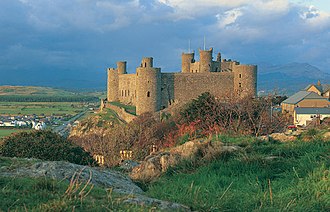
A dramatic clifftop fortress with a soaring modern 'floating' footbridge.
Immortalised in the song 'Men of Harlech', this World Heritage castle stands on a crag that once met the sea, now reached by a striking cantilevered footbridge, with Snowdonia behind.
Our tip The views to Snowdon and the sea from the walls are magnificent.
Visiting — good to know
Partial wheelchair access
The modern 'floating' footbridge gives a level, step-free route into the inner ward; beyond that, courtyard surfaces are uneven grass and stone, and the towers and walls are reached by steep spiral stairs only.
For blind & low-vision visitors A 'floating' bridge gives level access to the inner ward, but the towers have steep stairs and the rock-top setting has sheer drops all around.
Sensory Usually quiet and windswept with wide open views; the visitor centre is calm and the castle rarely crowded.
Access last checked 5 Jul 2026 — always confirm with the venue.
Worth watching
- HARLECH CASTLE, WALES | Walking Tour | Pinned on Places Pinned on Places
- Castles and Giants! Harlech - a Miss HubNut Guided Tour Miss Hubnut
- Harlech Castle - QT1-35 Sarah Woodbury's Quick Trips Sarah Woodbury
More Wikipedia
Beaumaris Castle

Edward I's last, most technically perfect (and unfinished) castle on Anglesey.
The greatest castle never finished — a textbook of concentric design with walls within walls and a moat, on the flat shore of Anglesey. World Heritage.
Our tip Its flat, symmetrical layout makes it one of the more approachable great castles.
Plan your visit
- Opening
- Seasonal: 1 July–31 August 09:30–18:00; 1 September–31 October 09:30–17:00; 1 November–28 February 10:00–16:00. Last entry is 30 minutes before closing. Closed 24–26 December and 1 January.
- Admission
- Adult £10.90 from 1 June–31 August 2026; disabled visitor and companion listed free. From 1 September 2026, adult £10.40.
- Booking
- Official online booking is available; a reservation requirement is not stated.
Visitor information checked 11 Jul 2026. Opening and prices can change.
Memberships and passes
- Cadw — entry included: Cadw membership includes standard admission to Beaumaris Castle during normal opening hours. Admission may be obtained on arrival or booked online; online booking only discounts paid tickets. The venue identifies the main town car park opposite but does not state its price or any Cadw member parking entitlement, so no parking benefit is claimed. Special occasions, out-of-hours events and separately charged events or exhibitions can cost extra. Each named member must show the original membership card, with identity if requested; no refund is due if the card is absent. Official terms (checked 11 Jul 2026)
Visiting — good to know
Partial wheelchair access Accessible parking Assistance dogs welcome
Ground-level viewing is possible; grass covers much of the site, with gravel between the outer and inner wards. Corridors have short, narrow staircases and internal steps; wall walks and corridor floors are uneven. There are no toilets onsite, but accessible public toilets are about 50 metres away via a flat, even route.
For blind & low-vision visitors The most level of the great Welsh castles — a low, moated, symmetrical ruin with largely even ground in the inner ward; tower stairs and the moat edge still need care.
Sensory A calm, low, open ruin that rarely feels busy or overwhelming, with moat birdlife and gentle town sounds.
Access last checked 11 Jul 2026 — always confirm with the venue.
Worth watching
More Tickets · Venue access information · Wikipedia
Also featured in Three days in North Wales
Caerphilly Castle

A vast moated fortress famous for its leaning tower.
The largest castle in Wales and second in Britain, ringed by great water defences, with a tower that leans more than Pisa's — a masterpiece of 13th-century military engineering.
Our tip The dramatic water defences and leaning tower are the signatures.
Plan your visit
- Admission
- Online ticket prices include a 5% discount and are non-refundable.
- Booking
- Admission tickets can be purchased on arrival or booked online to save 5%.
Visitor information checked 13 Jul 2026. Opening and prices can change.
Visiting — good to know
Accessible parking Accessible toilets Assistance dogs welcome
Step-free / wheelchair access not yet checked — please confirm with the venue.
Access last checked 13 Jul 2026 — always confirm with the venue.
Worth watching
- CAERPHILLY CASTLE, WALES | Walking Tour | Pinned on Places Pinned on Places
- Exploring Caerphilly Castle, Wales, United Kingdom Hope Begley UK
More Wikipedia
Pembroke Castle

A great riverside fortress with a soaring round keep, where Henry VII was born.
The birthplace of Henry Tudor (Henry VII), Pembroke's massive round keep and curtain walls rise above the Cleddau, with a vast natural cavern beneath.
Our tip Don't miss the Wogan Cavern beneath the castle.
Visiting — good to know
Partial wheelchair access
Cobbled, sloping approaches lead to a large, mostly open grassed interior with uneven surfaces; the great keep, wall-walks and the cavern beneath all involve steep stairs and rough ground, so only ground level can be experienced without steps.
For blind & low-vision visitors Cobbled, sloping approaches lead to a vast open interior; the Great Keep and wall-walks have steep spiral stairs and drops, and the cavern beneath is uneven.
Sensory Can be busy in the keep and halls, echoing stone within, but the large open interior and riverside give calmer space.
Access last checked 5 Jul 2026 — always confirm with the venue.
Worth watching
- Pembroke Castle Walk Around More Rural Stuff
- Pembroke Castle | Wales - Birthplace Of Henry VII Coaster Crazy
More Wikipedia
Cardiff Castle

A city-centre castle of a Norman keep and lavish Gothic-Revival apartments.
Two thousand years in one site — a Roman wall, a Norman motte-and-bailey and the fabulously opulent Victorian interiors the Marquess of Bute created with architect William Burges.
Our tip The over-the-top Burges interiors are the surprise highlight.
Access not yet checked — please confirm with the venue before you travel.
Worth watching
More Wikipedia
Scotland
Clifftop and loch-side strongholds where the nation's history was made.
Edinburgh Castle

The fortress over the capital, home of the Honours of Scotland and the One O'Clock Gun.
Perched on an extinct volcano above the city, Edinburgh Castle guards the Scottish Crown Jewels and the Stone of Destiny, fires its gun at one o'clock, and tells a thousand years of turbulent history.
Our tip Be near the Half Moon Battery for the One O'Clock Gun.
Plan your visit
- Opening
- Daily 09:30–18:00 (1 Apr–30 Sep) and 09:30–17:00 (1 Oct–31 Mar); last entry 1 hour before closing.
- Admission
- Adult £23.50 online or £26 in person; concession £19 online or £21 in person; child £14 online or £15.50 in person.
- Booking
- Book online in advance for the best price and guaranteed entry; once tickets are sold out online, no further tickets are available at the castle.
Visitor information checked 11 Jul 2026. Opening and prices can change.
Memberships and passes
- Historic Environment Scotland — entry included: Historic Scotland membership includes standard timed admission to Edinburgh Castle and Historic Scotland daytime events. Advance member-ticket booking is recommended to guarantee entry; once online tickets sell out there is no walk-up availability. There is no public parking at the castle; limited accessibility parking is separate and availability-limited. Third-party events and separately ticketed products require individual confirmation. Bring the member ticket plus a valid physical or digital membership card, temporary certificate or membership confirmation email. Official terms (checked 11 Jul 2026)
Visiting — good to know
Partial wheelchair access Accessible parking Accessible toilets Assistance dogs welcome Companion goes free — all visitors
Visitors enter over a wooden-slatted bridge and follow a steep, curved cobbled route; some areas have steps. A mobility vehicle and manual wheelchairs are available.
For blind & low-vision visitors Reached up the steep, cobbled esplanade; inside, routes are cobbled and stepped between levels (some lifts), and the ramparts have high open drops — busy and complex, a guide helps.
Sensory Very busy and crowded, with the One O'Clock Gun firing daily (a sudden loud bang), echoing closes and tour-group noise — the most sensory-intense castle; go early and be ready for the gun.
Companion concession Up to two accompanying carers receive free entry per transaction. Proof accepted: Proof of disability is not required.
Access last checked 11 Jul 2026 — always confirm with the venue.
Worth watching
- Touring Edinburgh Castle (With a wheelchair and pushchair) See Shaun Vlog
- 🏰 Edinburgh's Iconic Castle 🇬🇧 | Is it worth a visit? Phill & Fang Around the World
More Tickets · Venue access information · Wikipedia
Stirling Castle

A magnificent Renaissance palace-fortress on a commanding crag.
Whoever held Stirling held Scotland; its restored Renaissance palace glows with recreated tapestries and painted ceilings, above the field of Bannockburn.
Our tip The vividly recreated Royal Palace interiors are unmissable.
Plan your visit
- Booking
- Explore the castle at a specific date and time, with options for family and carer tickets.
Visitor information checked 13 Jul 2026. Opening and prices can change.
Memberships and passes
- Historic Environment Scotland — entry included: Historic Scotland membership includes standard timed admission to Stirling Castle and Historic Scotland daytime events. Advance member-ticket booking is recommended to guarantee entry; once online tickets sell out there is no walk-up availability. Castle parking is first-come, first-served for up to four hours: members pay half the £6 fee from April-September and park free from October-March. Third-party events and separately ticketed products require individual confirmation. Bring the member ticket plus a valid physical or digital membership card, temporary certificate or membership confirmation email. Official terms (checked 11 Jul 2026)
Access not yet checked — please confirm with the venue before you travel.
Worth watching
- Stirling, Scotland: Stirling Castle - Rick Steves’ Europe Travel Guide - Travel Bite Rick Steves' Europe
- DON'T Visit Stirling Castle till You've Watched THIS Scotland History Tours
More Wikipedia
Eilean Donan Castle

A romantic island castle joined to the shore by an arched bridge in the western Highlands.
On a tiny tidal island where three sea lochs meet, reached by a picturesque stone bridge, Eilean Donan is the very image of a Highland castle — rebuilt in the 20th century.
Our tip The classic view is from the shore, especially at sunset.
Plan your visit
- Booking
- Castle admission tickets can only be purchased on site, on the day of visit; there is no online ticket system for advance purchases.
Visitor information checked 13 Jul 2026. Opening and prices can change.
Visiting — good to know
Partial wheelchair access Accessible parking Accessible toilets
Access last checked 13 Jul 2026 — always confirm with the venue.
Worth watching
- The Official Eilean Donan Castle Promotional Video Eilean Donan Castle
- Eilean Donan Castle Walking Tour | Scotland in 4K Walking Walk Walks
More Venue access information · Wikipedia
Also featured in Three days in the Scottish Highlands
Urquhart Castle

A great lochside ruin with grandstand views for monster-spotting.
The shattered towers of Urquhart tumble down to the shore of Loch Ness — one of Scotland's most beautiful castle ruins, and a prime spot to scan the water for Nessie.
Our tip Climb the Grant Tower for the loch views.
Plan your visit
- Opening
- Urquhart Castle is open daily year-round except 25 and 26 December. Opening hours vary by season: 9.30am-8.15pm from 1 April to 31 August, 9.30am-6pm in September, 9.30am-5pm in October, and 9.30am-4.30pm from 1 November to 31 March, with shorter hours on 24 December (9.30am-4pm) and 1 January (11am-4pm). Last entry is one hour before closing, except on 24 December when last entry is 2.30pm.
- Admission
- Standard admission (online price / in-person price) is: Adult £14.00 / £16.00, Concession £11 / £13, Child aged 7-15 £8.50 / £9.50, and Historic Scotland members enter free; booking online in advance gives the best ticket price. Family tickets, Explorer Pass tickets and partner-organisation (English Heritage, Cadw, Manx National Heritage) tickets are also offered as categories, but their prices are not shown on the pages in this cache.
- Booking
- Tickets are sold online with timed availability. Parking is free but limited and must be booked online in advance — it can be added to your ticket booking before checkout. Motorhome and boat-mooring spaces also need advance booking.
Visitor information checked 12 Jul 2026. Opening and prices can change.
Visiting — good to know
Partial wheelchair access Companion goes free — all visitors
The car park is level and tarmac-surfaced with accessible bays, but reaching the visitor centre, shop, cafe and castle involves a steep tarmac ramp and a further steep tarmac path down to the castle; paths within the castle are tarmac or bound gravel, the Grant Tower is reached via wooden stairs, and the Watergate and the early-castle ruins/dovecot are down or up steep, stepped sections. Two mobility scooters and two wheelchairs are available on site on a first-come-first-served basis, with no booking.
For blind & low-vision visitors A lochside ruin on a steep, uneven slope below the visitor centre; paths down are sloped, the grassy ruins uneven, and the tower and loch edge have open drops.
Sensory The viewpoint and visitor centre can be busy with coach parties, but the open lochside ruin below is airy and calmer, with water sounds.
Companion concession Up to two accompanying carers receive free entry per transaction when accompanying a visitor with a disability. Proof accepted: Proof of disability is not required.
Access last checked 12 Jul 2026 — always confirm with the venue.
Worth watching
- INVERNESS, SCOTLAND: Loch Ness Cruise and Urquhart Castle TravelingJules
More Tickets · Venue access information · Wikipedia
Dunnottar Castle

Spectacular clifftop ruins on an almost-island of rock south of Stonehaven.
Perched on a sheer headland ringed by the North Sea, Dunnottar hid the Scottish crown jewels from Cromwell; its dramatic ruins are among Britain's most photogenic.
Our tip The approach and the setting are as memorable as the ruins.
Plan your visit
- Opening
- From 1 April to 30 September the castle is open 09:00–18:00, with last entry 1 hour before closing; other months use seasonal hours. It closes annually on 25–26 December and 1–2 January and may close at short notice because of high winds, snow or ice.
- Admission
- Prices published as valid to 31 March 2027: adult £13.50, concession £12, child age 5–15 £6.25, family of two adults and two children £36, and family of one adult and two children £24. Prices remain subject to change.
- Booking
- Tickets can be purchased online in advance or at the ticket kiosk on arrival; only card payments are accepted.
Visitor information checked 11 Jul 2026. Opening and prices can change.
Visiting — good to know
Not step-free Accessible parking Assistance dogs welcome
A relatively flat earth path runs approximately 300 metres from the car park to the cliff top. Reaching the castle requires 180 concrete steps, approximately 40 metres of earth path and 38 uneven steps. Inside are further uneven steps and surfaces of cobbles, earth and grass.
For blind & low-vision visitors Not accessible and hazardous for VI visitors: a cliff-top ruin reached by a steep path and a long flight of uneven steps, with sheer unfenced sea-cliff drops throughout.
Sensory Wild, windswept and rarely crowded once past the path, with constant sea and gull noise — elemental rather than busy.
Access last checked 11 Jul 2026 — always confirm with the venue.
Worth watching
- Secrets of Dunnottar Castle | Scotland’s Most INCREDIBLE Fortress Visit Scotland Tours
More Tickets · Venue access information · Wikipedia
Culzean Castle

An elegant 18th-century castle over the Ayrshire coast in a great country park.
Robert Adam's romantic clifftop castle, with its famous oval staircase and round drawing room over the Firth of Clyde, set in Scotland's first country park. National Trust for Scotland.
Our tip The oval staircase and the coastal country park are the highlights.
Plan your visit
- Opening
- Castle: 21 Mar–1 Nov, daily, 10.30–16.00 (last entry 15.30).
- Booking
- Please note that pre-booking is not required.
Visitor information checked 13 Jul 2026. Opening and prices can change.
Visiting — good to know
Partial wheelchair access Accessible toilets Assistance dogs welcome
Access last checked 13 Jul 2026 — always confirm with the venue.
Worth watching
Glamis Castle

The turreted childhood home of the Queen Mother, steeped in Shakespeare and ghosts.
A romantic pink-stone castle of turrets and towers, childhood home of the Queen Mother, birthplace of Princess Margaret, and the setting Shakespeare gave Macbeth.
Our tip The grand tree-lined avenue approach sets the scene perfectly.
Visiting — good to know
Partial wheelchair access
The long approach avenue and grounds are largely level, firm and well-defined; the castle interior is shown by guided tour with stairs between floors, so the upper rooms cannot be reached step-free.
For blind & low-vision visitors The interior is shown by guided tour with stairs between floors; the grounds and long approach avenue are largely level, firm and well-defined.
Sensory Guided tours keep groups together and it rarely feels crowded; the calm grounds and avenue are peaceful and open.
Access last checked 5 Jul 2026 — always confirm with the venue.
Worth watching
- Glamis Castle Photasma Travel
More Wikipedia
Before you go
The big castles (Windsor, Edinburgh, Warwick, the Tower) are run as full-day attractions and are busiest and priciest in the holidays — book online ahead and arrive early. Check each one's access note: some offer step-free routes to the grounds and main halls, while the towers and battlements are, almost always, a climb. And if you'd like to build a trip around a few, open the planner and shape it around how you travel — with your own access needs applied throughout.